
Adolf Hitler
| Adolf Hitler | |
| Born | Adolf Hitler 4/20/1889 |
|---|---|
| Birthplace | Braunau am Inn, Austria-Hungary |
| Died | 4/30/1945 Berlin, Germany |
| Nationality | Austrian (1889–1925), German (1932–1945) |
| Occupation | Politician, dictator |
| Title | Führer und Reichskanzler of Germany |
| Known for | Dictator of Nazi Germany, perpetrator of the Holocaust, instigator of World War II |
| Spouse(s) | Eva Braun (m. 1945) |
| Awards | Iron Cross First Class, Iron Cross Second Class |
Adolf Hitler (20 April 1889 – 30 April 1945) was an Austrian-born German politician who led the Nazi Party from 1921 and ruled Germany as dictator from 1933 until his suicide in 1945. He rose from obscurity as a failed art student and World War I soldier, then exploited the Weimar Republic's political and economic chaos to seize power first as chancellor, then as Führer und Reichskanzler, taking complete control of the German state. His expansionist foreign policy drove Europe directly into the Second World War, the deadliest conflict in human history. Under his direction, the Nazi regime carried out the Holocaust: the systematic, state-sponsored murder of roughly six million Jews, along with millions of Roma, disabled persons, political opponents, and countless others. His twelve-year rule devastated much of Europe, killed an estimated 70 to 85 million people during the war, and nearly destroyed Germany itself. On 30 April 1945, as Soviet forces closed in on Berlin, Hitler shot himself in his underground bunker.[1]
Early Life
Adolf Hitler was born on 20 April 1889 in Braunau am Inn, a small town on Austria-Hungary's border with the German Empire. His father, Alois Hitler, was a customs official. His mother was Klara Pölzl, his father's third wife. Of his six siblings, three died in infancy, leaving him to grow up with his younger sister Paula and his older half-siblings Alois Jr. and Angela. Alois was strict and authoritarian. Klara, by contrast, was loving and devoted.[2]
As a boy, Hitler showed artistic interest. He was fascinated by German nationalism, despite being Austrian. But he was a lazy student. He quit secondary school in Linz without finishing. His father died in 1903. His mother died of breast cancer in 1907. After that, he moved to Vienna seeking an art career. He failed the Academy of Fine Arts entrance exam twice. From about 1908 to 1913, he scraped by selling postcards and small paintings. These Vienna years were formative ones: he soaked up the city's antisemitic sentiments and pan-German nationalism, ideologies that would define him for life.[2]
In 1913, Hitler moved to Munich, Bavaria, partly to escape military service in the Austro-Hungarian army. When the First World War broke out in August 1914, he enlisted eagerly in the Bavarian Army. He served as a dispatch runner on the Western Front through major battles: First Ypres, the Somme, Passchendaele. Shrapnel wounded him in 1916. A mustard gas attack near Ypres in October 1918 blinded him temporarily. For his service, he received the Iron Cross Second Class in 1914 and the Iron Cross First Class in 1918, an unusual distinction for someone of his rank. The war profoundly shaped how he saw the world. Germany's defeat and the armistice of November 1918 left him feeling betrayed, a sentiment he shared with many Germans and which he'd later turn into political weapons.[2]
Career
Early Political Activity and the Nazi Party
After the First World War ended, Hitler stayed in the army and was assigned to an intelligence unit watching political groups in Munich. In September 1919, he attended a meeting of the German Workers' Party, founded by Anton Drexler. He joined and quickly became one of the party's most compelling speakers. His fiery talks blamed Germany's problems on Jews, Marxists, and the politicians who'd signed the Treaty of Versailles. Increasingly large crowds came to hear him. In February 1920, the party was renamed the National Socialist German Workers' Party, or Nazi Party. By July 1921, Hitler had maneuvered himself into the role of party chairman with near-absolute control.[2]
He built the party's ideology around radical antisemitism, anti-communism, and pan-Germanism. At its core was the concept of Lebensraum, or living space: the idea that Germans needed to expand territorially, especially into Eastern Europe. He gathered loyal followers like Hermann Göring, Rudolf Hess, and Ernst Röhm. He created the Sturmabteilung, or SA, a paramilitary force that used violence and intimidation against political enemies.[2]
The Beer Hall Putsch and Mein Kampf
On 8 and 9 November 1923, inspired by Benito Mussolini's March on Rome the year before, Hitler led the Nazi Party in a coup attempt called the Beer Hall Putsch in Munich. It was poorly organized and failed when police fired on the marchers, killing sixteen Nazis and four police officers. Hitler was arrested, tried for treason, and sentenced to five years. He served just over one year.[2]
While in prison, he dictated the first volume of Mein Kampf (My Struggle) to Rudolf Hess. This autobiographical manifesto laid out his racial theories, his hatred of Jews, his contempt for democracy, and his vision of German expansion. A second volume came in 1926. The book didn't sell well at first, but after 1933 it became the Nazi movement's foundational text and was widely distributed across Germany.[2]
Rise to Power
Released from prison in December 1924, Hitler rebuilt the Nazi Party with a different approach. Instead of taking power by force, he'd pursue it legally, exploiting the Weimar Republic's democratic institutions. Through the late 1920s, the party remained marginal in German politics. Then came the Great Depression in 1929. Mass unemployment, economic despair, and political chaos pushed millions of Germans toward radical movements on both left and right.[3]
Hitler's charisma, paired with Joseph Goebbels' sophisticated propaganda campaigns, transformed the Nazi Party into a mass movement. He attacked the Treaty of Versailles, pushed pan-Germanism, and blamed Jews and communists for Germany's problems. By July 1932, the Nazi Party was the largest in the Reichstag, though never with a majority in free elections. In the November 1932 elections, their vote share dropped slightly, yet they still held more seats than anyone else.[2]
Berlin was politically deadlocked. Former chancellor Franz von Papen and other conservative politicians convinced President Paul von Hindenburg to appoint Hitler as chancellor on 30 January 1933. The conservatives thought they could control him and use his popularity for their own purposes. They were catastrophically wrong.[2]
Consolidation of Power
Within weeks, Hitler dismantled the Weimar Republic's democratic structures. On 27 February 1933, fire engulfed the Reichstag building. He used it as a pretext to push Hindenburg into issuing the Reichstag Fire Decree, which suspended civil liberties and allowed mass arrests of political opponents, mainly communists. On 23 March 1933, the Reichstag passed the Enabling Act. This gave Hitler the power to enact laws without parliament. Democracy in Germany was effectively finished.[4]
Over the following months, he banned all other political parties, created a one-party state, and purged rivals within his own movement. On 30 June 1934, in the Night of the Long Knives, he ordered the murder of Ernst Röhm and other SA leaders, along with several conservative politicians who'd fallen out of favor. The cabinet retroactively legalized the purge, and it consolidated Hitler's hold over both party and military. When President Hindenburg died on 2 August 1934, Hitler merged the offices of chancellor and president. He took the title Führer und Reichskanzler, and every armed forces member swore personal loyalty to him.[4]
Domestic Policy and Persecution
Hitler transformed Germany into a totalitarian state. The Nazi government controlled the press, censored the arts, and used propaganda extensively to maintain support. It invested heavily in public works like the Autobahn highway system and rearmed in violation of the Treaty of Versailles. Unemployment dropped markedly in the early Nazi years, which made Hitler popular with much of the German public.[5]
But these economic gains came alongside intensifying persecution of Jews and other minorities. Starting in 1933, the regime passed a series of antisemitic laws that systematically stripped Jews of their rights, their livelihoods, and their standing in society. The Nuremberg Laws of 1935 made Jews non-citizens and prohibited marriage or sexual contact between Jews and non-Jews. On 9 and 10 November 1938, the regime orchestrated Kristallnacht, the Night of Broken Glass. Nazi paramilitaries and civilians destroyed Jewish businesses, synagogues, and homes, killed dozens, and arrested roughly 30,000 Jewish men who were sent to concentration camps.[4]
World War II
Hitler's foreign policy in the 1930s was fundamentally expansionist. He aimed to undo the Treaty of Versailles and establish German dominance over Europe. In March 1936, he remilitarized the Rhineland. In March 1938, he orchestrated the Anschluss, the annexation of Austria into the Reich. In September 1938, at the Munich Conference, British Prime Minister Neville Chamberlain and French Prime Minister Édouard Daladier gave in to Hitler's demand for the Sudetenland, the German-speaking border regions of Czechoslovakia. This became the symbol of failed appeasement. In March 1939, Hitler broke the Munich Agreement by occupying the rest of Czechoslovakia.[6]
On 1 September 1939, Germany invaded Poland. Britain and France declared war on Germany two days later. The Second World War in Europe had begun. The initial phase brought rapid German victories. Denmark, Norway, the Netherlands, Belgium, Luxembourg, and France all fell to German forces in 1940. Hitler directed much of the overall military strategy, though his generals handled the day-to-day operational planning.[7]
In June 1941, Hitler launched Operation Barbarossa, the invasion of the Soviet Union. He sought Lebensraum and the destruction of what he saw as "Judeo-Bolshevism." The invasion initially achieved dramatic territorial gains, but failing to capture Moscow before winter and encountering the Soviet military's enormous resilience turned the campaign into a grinding war of attrition. In December 1941, after the Japanese attacked Pearl Harbor, Hitler declared war on the United States, bringing the world's largest industrial power fully into the fight against Germany.[4]
The Holocaust
The Holocaust was the ultimate expression of the Nazi regime's antisemitism. From the invasion of the Soviet Union in 1941 onward, mobile killing squads called Einsatzgruppen massacred Jews, Roma, and other targeted groups in occupied Eastern Europe through mass shootings. In January 1942, senior Nazi officials met at the Wannsee Conference to coordinate the "Final Solution to the Jewish Question": the systematic deportation and murder of European Jews in extermination camps like Auschwitz-Birkenau, Treblinka, Sobibór, and Belzec.[8]
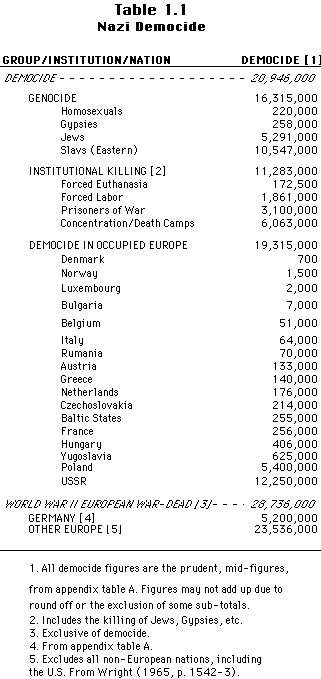
Six million Jews died in the Holocaust. Millions of others perished too: Roma, Slavic civilians, Soviet prisoners of war, disabled persons, homosexuals, and political and religious dissidents. The genocide used mass shootings, gas chambers, forced labor, starvation, and death marches. Hitler didn't sign a single order for the Holocaust, but substantial evidence establishes his central role. His speeches, recorded directives, and the testimony of senior Nazi officials all demonstrate his personal involvement.[9]
Defeat and Death
By 1943, the war's momentum had shifted decisively against Germany. Stalingrad fell catastrophically in February 1943. The Allies invaded Italy that same year. D-Day came in Normandy in June 1944. Germany now fought a two-front war with dwindling resources. Hitler increasingly secluded himself in his military headquarters, making strategic decisions his generals often opposed. His health deteriorated noticeably.[4]
On 20 July 1944, German military officers and civilians attempted to assassinate Hitler at the Wolf's Lair, his field headquarters in East Prussia. Claus von Stauffenberg placed a bomb that detonated but failed to kill him. The crackdown afterward resulted in the execution of thousands of suspected conspirators and further tightened Hitler's grip on the military.[4]
As Soviet forces advanced on Berlin in April 1945, Hitler retreated to his underground bunker, the Führerbunker, beneath the Reich Chancellery. On 29 April 1945, he married his longtime companion Eva Braun in a brief civil ceremony. The next day, 30 April 1945, both died by suicide. Hitler shot himself. Braun took cyanide. Their bodies were carried to the garden above the bunker and burned according to Hitler's instructions.[10] Historian Hugh Trevor-Roper was among the first scholars to investigate and reconstruct Hitler's final days, producing an account that remains foundational to the subject.[11]
Germany surrendered unconditionally on 8 May 1945, one week after Hitler's death.
Personal Life
Hitler's personal life was shrouded in secrecy. He cultivated a public image as a leader devoted entirely to Germany. He had a relationship with Eva Braun starting in the early 1930s, but kept it hidden from the German public. Braun lived at Hitler's mountain retreat, the Berghof, near Berchtesgaden, but rarely appeared at official events. They married on 29 April 1945, the day before their joint suicide. Hitler had no children.[4]
He was a vegetarian for much of his adult life and strongly opposed tobacco smoking. His regime launched one of the first public anti-smoking campaigns in modern history.[12] He drank little to no alcohol. His health declined in his later years. He experienced tremors and other symptoms. Some medical historians attribute these to Parkinson's disease, but definitive diagnosis remains contested among scholars.[13]
Architecture fascinated him. He worked closely with architect Albert Speer on grandiose plans to rebuild Berlin, to be renamed Germania. His personal library was enormous. He'd stay up late into the night delivering lengthy monologues to his inner circle.
Legacy
Adolf Hitler's legacy is one of genocide and destruction, the near-total ruin of European civilization. The war he started killed an estimated 70 to 85 million people, making it history's deadliest conflict. The Holocaust stands as one of the defining atrocities of our era. The systematic, industrial-scale murder of six million Jews shaped the postwar world profoundly, directly leading to the creation of the State of Israel and to the development of international law on genocide and crimes against humanity.[14]
Nazi Germany's defeat resulted in the division of Germany into East and West, the onset of the Cold War, and a fundamental restructuring of European politics. The Nuremberg Trials of 1945 and 1946 prosecuted senior Nazi leaders for war crimes, crimes against humanity, and crimes against peace. They established a crucial principle: individuals, including heads of state, could face accountability under international law for wartime atrocities.
In Germany, Nazi rule's legacy prompted extensive processes of Vergangenheitsbewältigung, or coming to terms with the past. The nation imposed legal prohibitions on Nazi symbols and Holocaust denial. Hitler's regime became a central reference point in political discourse worldwide, frequently invoked as the paradigmatic example of totalitarian evil and the consequences of unchecked authoritarianism and racial hatred.[15]
Historians have studied Hitler exhaustively, producing one of the largest bodies of biographical and analytical literature on any single historical figure. Biographer Ian Kershaw, whose two-volume work Hitler: Hubris and Hitler: Nemesis is considered among the most authoritative accounts, emphasized the interplay between Hitler's personal agency and the structural conditions that enabled his rise.[2][4] Scholars have also extensively analyzed the psychological dimensions of Hitler's character: his narcissism, paranoia, and capacity for violence.[16]
His name and image remain potent symbols of hatred and extremism. The study of his rise to power continues to inform scholarly and public discussions about how fragile democratic institutions really are, the dangers of demagogues, and the mechanisms by which ordinary societies can become instruments of mass violence.
References
- ↑ "Adolf Hitler". Encyclopaedia Britannica. Retrieved 2026-03-12.
- ↑ 2.00 2.01 2.02 2.03 2.04 2.05 2.06 2.07 2.08 2.09 "Hitler: 1889–1936: Hubris". W. W. Norton & Company. Retrieved 2026-03-12.
- ↑ "The Road to War". Random House. Retrieved 2026-03-12.
- ↑ 4.0 4.1 4.2 4.3 4.4 4.5 4.6 4.7 "Hitler: 1936–1945: Nemesis". W. W. Norton & Company. Retrieved 2026-03-12.
- ↑ "The Dictators: Hitler's Germany and Stalin's Russia". W. W. Norton & Company. Retrieved 2026-03-12.
- ↑ "The Munich Crisis, 1938". Frank Cass. Retrieved 2026-03-12.
- ↑ "The Origins of the Second World War". Arnold. Retrieved 2026-03-12.
- ↑ "Rethinking the Holocaust". Yale University Press. Retrieved 2026-03-12.
- ↑ "Nazi Democide: Table 1.1". University of Hawaii. Retrieved 2026-03-12.
- ↑ "Hitler's Death: Russia's Last Great Secret from the Files of the KGB". Chaucer Press. Retrieved 2026-03-12.
- ↑ "Hitler's last days: the first draft of history". Engelsberg Ideas. 2026-03-11. Retrieved 2026-03-12.
- ↑ "The Nazi War on Cancer". Princeton University Press. Retrieved 2026-03-12.
- ↑ "The Medical Casebook of Adolf Hitler". William Kimber. Retrieved 2026-03-12.
- ↑ "Fires of Hatred: Ethnic Cleansing in Twentieth-Century Europe". Harvard University Press. Retrieved 2026-03-12.
- ↑ "The Meaning of Hitler". Harvard University Press. Retrieved 2026-03-12.
- ↑ "The Psychopathic God: Adolf Hitler". Basic Books. Retrieved 2026-03-12.
- 1889 births
- 1945 deaths
- Austrian people
- German people
- Politicians
- Dictators
- People from Braunau am Inn
- German military personnel of World War I
- Heads of state of Germany
- Chancellors of Germany
- Nazi Party politicians
- Holocaust perpetrators
- People who committed suicide
- Austrian emigrants to Germany
- Iron Cross recipients